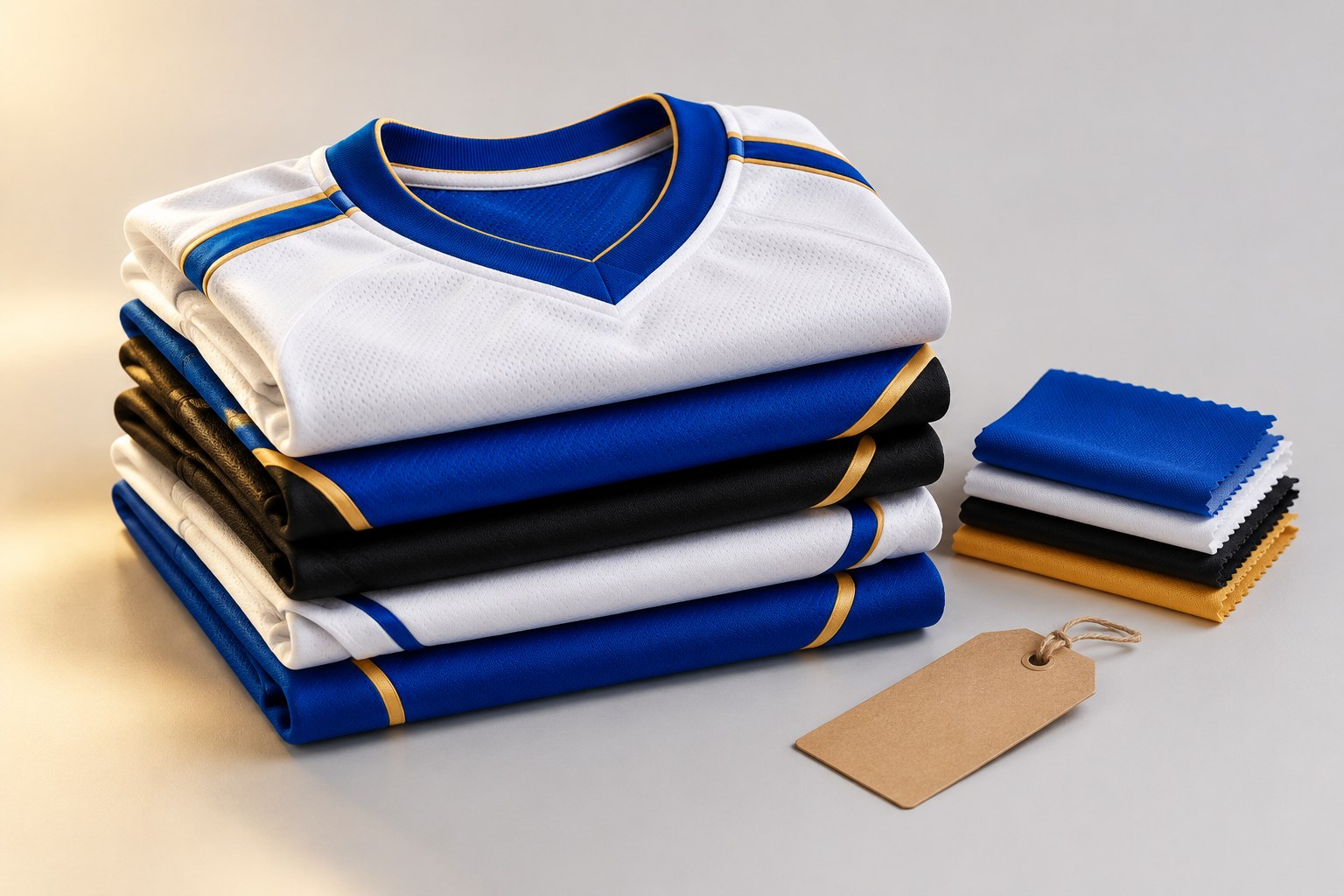
Ask any teamwear supplier two questions and you will learn a lot about how they work: "What is your minimum order?" and "Why does the price change so much with quantity?" The second question is the important one. A minimum order quantity (MOQ) is not a number a factory picks to filter customers — it is a direct result of how custom sportswear is actually made. Once you understand the cost structure behind it, every quote you receive starts to make sense.
Why custom jerseys have a minimum order in the first place
A custom sublimated jersey is not pulled off a shelf. Before a single piece is sewn, several fixed costs are already on the table:
- Artwork and mockup development. Your logos are vectorized, colors are matched, placement is set and a digital mockup is produced. A good factory does this free for serious inquiries, but it is still days of design work that has to be paid for by the order.
- Fabric supply. Sportswear fabric is sold by the roll or by the kilogram. Basic colors can sometimes be bought in small lots, but any custom-dyed color starts at 100–300 meters — enough for roughly 40–120 jerseys. A ten-piece order in a unique colorway means buying (and paying for) far more fabric than you need.
- Cutting and printing setup. The fabric is printed as a large sheet, then cut and sewn. Setting up a print run and a cutting table for a handful of pieces costs almost as much as for 100.
- Quality control and packing. Every order goes through inspection, counting, folding and packing — a fixed process regardless of size.
None of this means small orders are impossible. It means the fixed costs must be spread across fewer pieces, and that is exactly what shows up in your quote.
What actually drives your unit price
Five variables decide what you pay per jersey, roughly in this order of impact:
- Quantity. The single biggest factor. Doubling the order typically cuts the unit price by 5–12%, mostly by diluting fixed setup costs.
- Design complexity. A two-color design and a full-coverage graphic layout use the same machine but different print coverage and prep time. Complex all-over prints usually add 8–15% versus simple designs.
- Fabric spec. A standard 160gsm interlock and a heavyweight 240gsm double-knit sit in different price brackets — often 10–20% apart.
- Sewing details. Contrast ribbed collars, side vents, zippers, taped seams and linings all add labor. Each detail is small; three or four together are not.
- Packing and shipping. Individual poly-bags, custom boxes and hang tags add up. And the shipping method — express courier versus consolidated freight — can swing the delivered cost more than the jersey itself on small orders.
The real price ladder
For a standard full-sublimated team kit (common fabric, moderate design), this is how quotes typically move as quantity grows. Treat these as realistic factory-direct ranges, not promises — your exact number depends on the specification:
| Quantity | Typical unit price (FOB) | What changes |
|---|---|---|
| 10–50 pcs | US$18–28 | Fixed costs concentrated; often limited to stock fabric colors |
| 100 pcs | US$13–18 | The standard MOQ sweet spot; custom colors become viable |
| 300 pcs | US$11–15 | Fabric bought in volume; longer print runs |
| 500+ pcs | US$9–13 | Best fabric pricing; size-curve optimization |
If a quote you receive is dramatically below these ranges, the question is not "how did they do it" but "what did they leave out" — usually fabric spec, quality control, or both.
Where teams actually save money
In practice, the biggest savings rarely come from negotiating the unit price down. They come from ordering smart:
- Gather the full roster before ordering. Two separate orders of 60 and 40 pieces cost more than one order of 100 — and a later "add 12 more" order costs the most of all.
- Combine squads or seasons. Most clubs run several age groups. Placing one combined order, with color blocks per team, is one setup instead of five.
- Avoid the spring rush. March to May is peak season for team orders worldwide. Placing orders in late summer or autumn gets you better attention and sometimes better scheduling.
- Simplify where it does not show. Nobody on the sideline notices taped seams, but everybody notices a late delivery caused by twenty extra production steps.
- Keep your design files. Reorders are the cheapest orders of all — same artwork, same colors, no setup on your side.
One more thing: a factory that solves problems quickly is worth more than a 5% cheaper quote. Replacing fifteen misprinted jerseys out of two hundred costs more than the discount ever saved.
Red flags in a suspiciously cheap quote
- Fabric described only as "good quality" — no GSM, no fiber spec, no sample offered.
- No mockup before payment, or a mockup that does not reflect your brief.
- Shipping quoted as FOB only, with the real freight cost revealed later. If you want a true landed cost, ask for a delivered (DDP) number.
- "Free" artwork that quietly locks you into a quantity you never agreed to.
- No clear production timeline — or one that sounds too good. A three-day turnaround for two hundred custom pieces is a promise worth doubting.
How to order below the MOQ (honest options)
Sometimes you genuinely only need a few pieces: a sample for approval, a single small team, a pilot run. The honest options, in order of cost-effectiveness:
- A paid sample or trial order. Most factories, including ours, offer a small trial-order channel — a few pieces at sample pricing, with a per-unit price that is obviously higher. It is the right way to check quality before committing.
- Combine with another buyer. Two clubs ordering together can reach the 100-piece tier without either one over-ordering.
- Stock blanks plus heat transfer. For very small runs, printing names and numbers onto stock garments can beat a full custom run on cost.
The bottom line
MOQs and price ladders exist because of setup, fabric and handling realities — not gatekeeping. If you approach a factory with a clear brief — sport, quantity, design direction, delivery country and deadline — you will get a real number, usually the same day, and you will know exactly what that number is buying. Send us your requirements and we will price your project line by line.