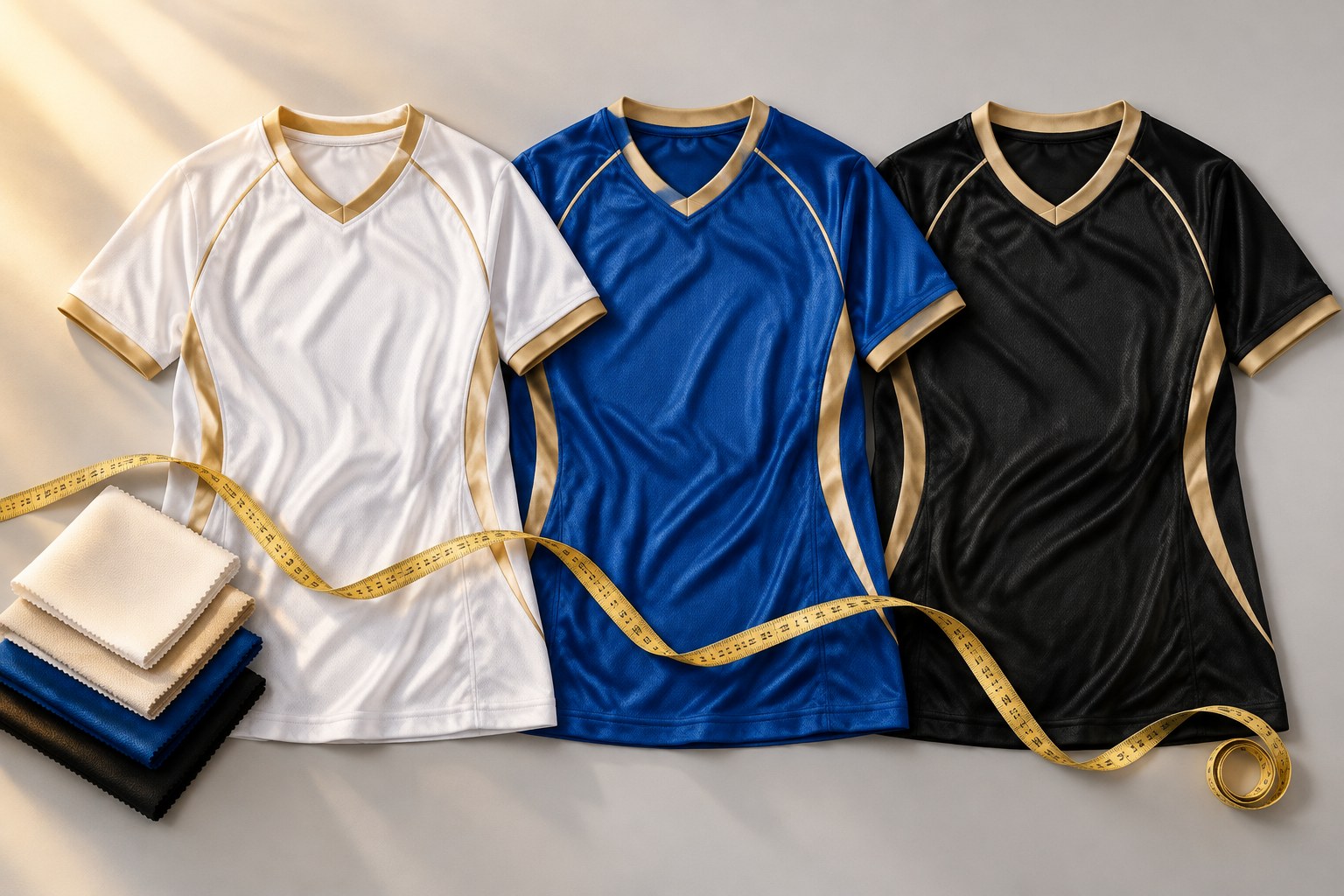
Every week we cut team orders at our factory, and every week we see the same thing: the design is perfect, the fabric is right, the price was agreed — and then forty percent of the jerseys don't fit anybody properly. Sizing is the least glamorous part of ordering custom kit, and it's the part that decides whether your players wear the shirts or leave them folded in a kit bag. This guide covers how to measure players correctly, how to read a size chart, and how to hand a factory a size breakdown that produces a team that actually looks like a team.
Why sizing goes wrong in bulk orders
In a retail store, a wrong size is an exchange. In a bulk custom order, a wrong size is a remake — and remakes are the single most expensive mistake in teamwear. Custom jerseys are printed and cut to your order; there is no shelf to swap sizes from. If twelve pieces come out too small, your options are a small remake run (which costs far more per piece than your original order), or players spending the season in the wrong size.
The root cause is almost never the factory. It's the data. Teams collect sizes in three unreliable ways: asking players what they usually wear (people genuinely don't know), guessing from age, or assuming that a size from a local brand will match a sportswear cut. None of these survive contact with an actual size chart.
The four measurements that actually matter
You don't need a tailor. You need two numbers per player, plus two cross-checks. Measure over light clothing, keep the tape level and snug — not tight — and never measure with pockets full of keys.
- Chest. Around the fullest part of the chest, tape under the arms, arms relaxed at the sides. This is the number that decides most jersey sizes.
- Waist. Where the player actually wears their waistband — not the narrowest point, since nobody wears shorts above their hips for a reason.
- Height. A cross-check that catches growth spurts and unusually tall or short builds.
- Weight. A second cross-check for stocky or slim builds where chest alone lies.
For teams of more than fifteen people, there is a faster method that works surprisingly well: the flat-lay shirt test. Have each player bring a jersey or T-shirt they consider a good fit. Lay it flat, measure armpit-to-armpit (half-chest), and double it. Compare that number against the size chart. Because it measures the garment rather than the body, it sidesteps how players usually guess, and it takes thirty seconds per player.
How to read a size chart without being fooled
The first trap is mixing up body measurements (what you measured) with garment measurements (the finished piece). A chart that lists "M: chest 100 cm" might mean the shirt measures 100 cm around — roughly 6–10 cm of ease over a 90–94 cm chest. A chart that lists "M: fits chest 94–100 cm" means something different. Always check which one you're reading.
The second trap is tolerance. Every chart is a target, not a promise: industry-standard sewing tolerance for sportswear is ±1–1.5 cm on major measurements, and no factory in the world delivers fifty pieces with identical numbers. This is normal, and it is also why the measuring method matters more than squeezing half a centimetre out of the chart.
For reference, this is the standard adult fit across the kits we produce (body measurements, not garment measurements):
| Size | Chest | Waist | Height |
|---|---|---|---|
| S | 86–92 cm / 34–36 in | 72–78 cm | 158–168 cm |
| M | 92–98 cm / 36–38.5 in | 78–84 cm | 165–175 cm |
| L | 98–104 cm / 38.5–41 in | 84–90 cm | 172–182 cm |
| XL | 104–110 cm / 41–43.5 in | 90–96 cm | 178–188 cm |
| 2XL | 110–116 cm / 43.5–45.5 in | 96–102 cm | 182–192 cm |
| 3XL | 116–122 cm / 45.5–48 in | 102–108 cm | 185–195 cm |
| Youth S (6–8y) | 64–70 cm | 58–62 cm | 112–124 cm |
| Youth M (8–10y) | 70–76 cm | 62–66 cm | 124–136 cm |
| Youth L (10–12y) | 76–82 cm | 66–70 cm | 136–148 cm |
| Youth XL (12–14y) | 82–88 cm | 70–74 cm | 148–158 cm |
Two notes. First, at the boundaries — a player measuring exactly 98 cm belongs in either M or L, and that's a preference call, not a math error. Second, if you're comparing against Asian domestic sizing, do not assume equivalence: an Asian L often sits between a US M and a US L depending on the brand. When in doubt, measure, don't convert.
Fit types: what suits which sport
Sizes are only half the story — cuts differ by sport, and ordering the wrong cut makes a correct size feel wrong. What we recommend in practice:
- Soccer: a regular, slightly relaxed cut so the jersey moves without flapping. Our men's sublimated training top is cut this way, and full kit orders like the full-body print uniform set are graded so jersey and shorts sizes stay consistent with each other.
- Basketball: deliberately loose, with longer body and wider armholes for shoulder freedom. If your players are between sizes, size down here, not up — a basketball uniform set that's too large is visibly a size too large.
- Volleyball, badminton and racket sports: closer to the body, because a loose collar edge or floating hem distracts during overhead play. Unisex cuts dominate, and women's cuts follow the same chart with a shaped waist — our sublimated volleyball set is a good example of a unisex cut that teams rarely need to alter.
- Rugby and American football: heavyweight and generous, and this is the one sport where you size up without hesitation. Contact jerseys have to clear shoulder padding and grip during tackles — a rugby jersey set ordered in training-fit will not go over pads, no matter how the size chart reads.
- Baseball: button-front jerseys are sized to be worn open or closed over an undershirt, so keep the chest measurement slightly generous. A quick-dry baseball jersey in the chart size usually lands right for players wearing a base layer.
Youth teams and women's cuts
Youth sizing has one golden rule: measure now, and order for the season, not for the jacket size the parents insist on. Kids between 8 and 13 can grow 5–8 cm in a year. If your season runs long, take the current measurement and go one size up at the smaller end of the chart — but resist going up two. A jersey that hangs past a child's shorts looks like a hand-me-down, and parents notice.
For women's teams, the chest and waist numbers both matter, and a women's cut is not simply a smaller unisex cut — the waist is shaped and the hem is shorter. When a club orders mixed men's and women's pieces from the same design, we cut them from the same print sheet, so the color and design stay identical across both.
One more youth-specific note: for training vests and scrimmage tops, players often wear a jersey underneath, so vests are cut one size more generous on purpose — the same reason a mesh scrimmage vest asked for in "jersey size" still fits over one.
Building the size breakdown
The size breakdown is the spreadsheet you send with the order: how many pieces per size. A few factory-side realities worth knowing before you build it:
- Every size in the run costs a little. Each size needs its own pattern grading, cutting marks and count. Ordering S–XL only keeps things simple; adding 2XL and 3XL or youth sizes is fine, but a run of thirteen pieces spread across eight sizes will be quoted higher per piece — and any honest factory will tell you so upfront.
- Extreme sizes are priced honestly, not punished. Sizes 2XL and above genuinely use more fabric, and it's normal for them to carry a small surcharge. If a supplier hides that in a blended price, ask what the 3XL surcharge is.
- Jersey sizes and shorts sizes are not always the same person-size. Players with a large chest and small waist (or the reverse) should give both numbers, and where you see this pattern across a squad, split the breakdown so shorts and jerseys are ordered independently.
- Send a sample size set through approval. For orders of 100+ pieces, we produce one piece per size as a pre-production size set. Teams try it on, confirm, then we release the bulk run. It adds a few days and saves remakes.
If you're weighing up how size spread affects your quote, the mechanics of volume and fixed costs are explained in our MOQ and pricing guide.
The five sizing mistakes we see most
- Collecting numbers by email from players. A third of them guess. Use one measurement session, or the flat-lay shirt test at a training day.
- Treating the shorts as an afterthought. Kit shorts are graded separately from the jersey cut, and teams that only collect one set of sizes end up with shorts that fit nobody correctly.
- Assuming the last order's sizes still fit. Roster and bodies change every season. Re-measure juniors every single year.
- No size set before bulk production. If a factory is willing to print 300 pieces without a single fitting piece, be curious about why.
- Chasing a perfect 0.5 cm. The tolerance exists, the bodies vary more than that, and a fit session will tell you more than a debate about chart rows. If fabric choice is part of your keep-or-swap list, our fabric and GSM guide covers what actually changes how a jersey feels — and how it drapes on different builds.
Sizing checklist before you order
- Measure chest and waist per player, over light clothing, tape level and snug.
- Cross-check with height and weight for unusual builds.
- Compare against the size chart above — or the flat-lay test if measuring people isn't practical.
- Decide fit preference at the boundary sizes (M or L means "close or roomy").
- Split jersey and shorts counts where the squad needs it.
- Confirm 2XL+ quantities so surcharges and fabric planning are explicit.
- Ask for a pre-production size set if your order is 100+ pieces.
- Keep the final breakdown as one document — and keep it for reorders.
Frequently asked questions
What if I can't measure every player?
Order a single testing piece in two or three sizes first, have your key players try them on, and scale from there. It costs a little more upfront and is still cheaper than a remake run.
Do large sizes cost more?
2XL and above typically carry a small surcharge that reflects actual fabric use — usually a few percent on those pieces, not on the whole order. Ask for the number in the quote so there are no surprises.
Should we size up for growth?
For juniors, one size up at the bottom of the chart is sensible for long seasons. More than that turns a team kit into a tent. If in doubt, keep the fit right today and reorder next season — reorders on the same design are the cheapest pieces you'll ever buy.
Can players order their own sizes later?
Usually the club holds the order minimum, but replacement pieces for late joiners are possible when we already have the design and size artwork on file. Give the factory the returning player's size and the order continues at the same colors — no new setup on your side.
Get the fit right the first time
If you're ready to move, browse the full range of custom teamwear we manufacture, pick the sport, and send the size breakdown with your inquiry. We'll check it against the cut, flag anything that looks off, and lock the fit before a metre of fabric is printed. Questions about a specific squad — mixed men's and women's, growing kids, contact sports with pads — just send us the details, and you'll get an answer from the people who cut the order, not a call centre.