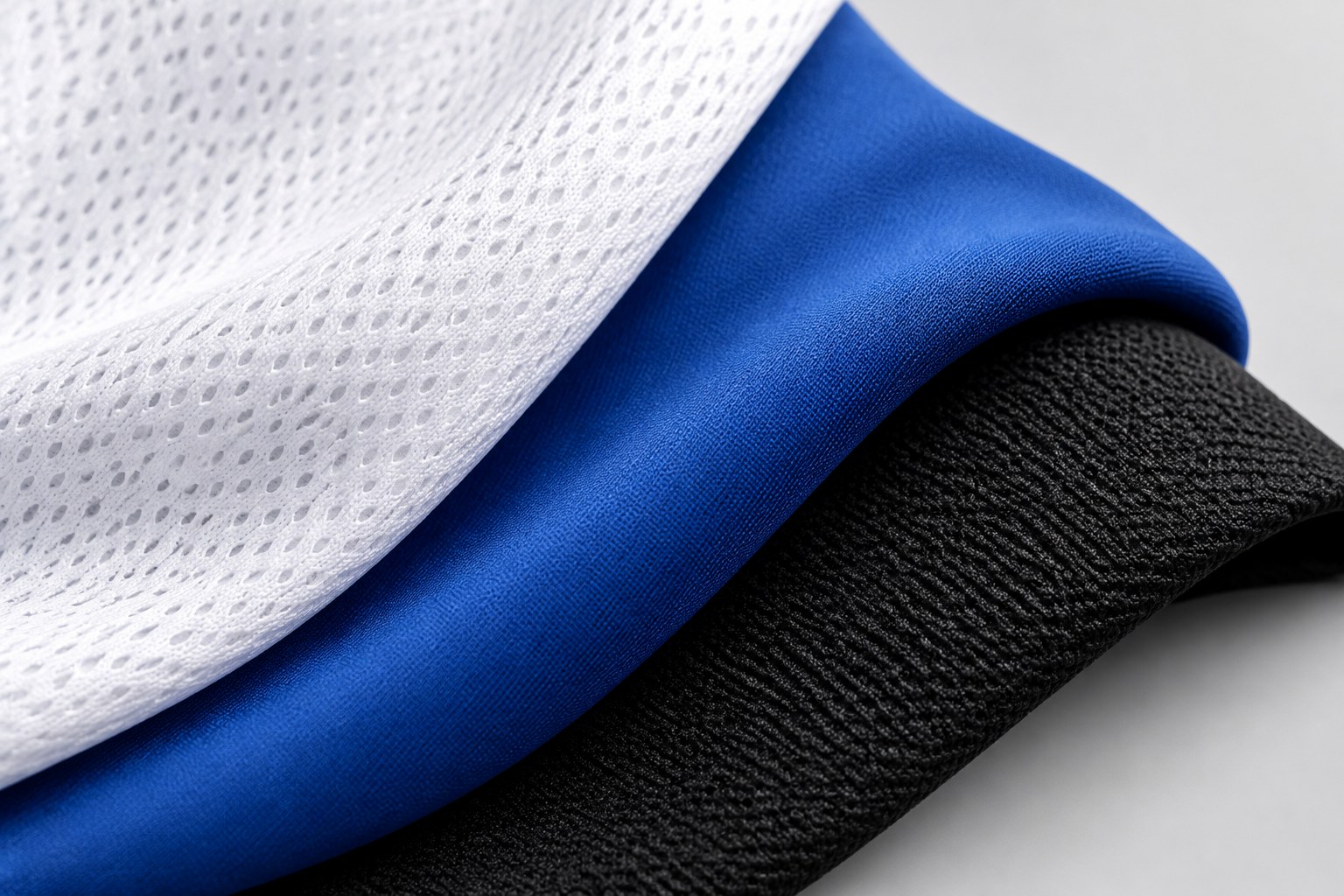
Every kit inquiry eventually reaches the same question: "What fabric do you use?" The honest answer is that there is no single best fabric — there is a right fabric for your sport, your climate and your budget. And the number most people use to compare fabrics, GSM, tells less than they think. Here is how we actually think about fabric when quoting orders, and how you can use the same framework.
What GSM actually means — and what it does not
GSM stands for grams per square meter: literally how much one square meter of the fabric weighs. A 160gsm jersey fabric weighs 160 grams per square meter; a 260gsm one weighs 260. It is the fastest way to compare heft, but it says nothing about fiber quality, weave structure or finish on its own.
Think of it like vehicle weight. A heavier car is not automatically safer or better — it depends on how it is built. The same goes for jersey fabric: a well-made 150gsm mesh beats a sloppy 200gsm knit every time, for summer play.
The four fabrics you will actually be quoted
1. Mesh — the light, breathable workhorse (140–180gsm)
Mesh has visible micro-perforations that move air and moisture fast. It is the standard for warm-weather outdoor sports and for anyone who runs hot. The trade-off: very light mesh below 150gsm can snag and feels less substantial, so anything sold for serious use should be 150gsm or above.
2. Interlock — the industry standard (150–220gsm)
Interlock is a smooth, double-sided knit with excellent shape retention and the best surface for sublimation printing — colors stay crisp because the print bonds into the fiber rather than sitting on top of it. Most basketball, soccer and volleyball kits are interlock for good reason.
3. Piqué — the structured, matte finish (180–230gsm)
Piqué has a subtle waffle-like texture, a matte look and more structure than interlock — which is why it dominates polos, tennis and golf wear. It also takes embroidery beautifully, making it the go-to choice when logos will be stitched rather than printed.
4. Heavyweight knit — built for contact (230–300gsm)
Ice hockey and American football kits use heavyweight double-knit fabric for a simple reason: it survives grabbing, board contact and constant abrasion. It hangs heavier, feels armor-like, and is deliberately overkill for any non-contact sport.
What we would pick by sport
| Sport | Recommended fabric | Typical GSM | Why |
|---|---|---|---|
| Soccer / football | Mesh or light interlock | 150–170 | Ninety minutes of running — ventilation first |
| Basketball | Interlock | 160–190 | Best print surface; holds shape through a season |
| Baseball / softball | Interlock | 170–190 | Button plackets need body and structure |
| Volleyball | Interlock or mesh | 150–180 | Indoor play; smooth print for large graphics |
| Ice hockey | Heavyweight double-knit | 240–300 | Abrasion and board contact |
| American football | Heavyweight double-knit | 240–280 | Padding straps and turf friction |
| Polo / golf / casual | Piqué | 190–220 | Structure, matte look, embroidery-friendly |
| Running / track | Mesh | 130–155 | Minimum weight, maximum airflow |
Breathability vs durability vs print quality
These three pull against each other, and every fabric choice is a trade-off:
- Print quality comes from a smooth, polyester-based knit. This is also why full-sublimation jerseys are polyester: the dye turns to gas and bonds with polyester fiber. Cotton and high-cotton blends simply cannot take a full-color sublimated design.
- Breathability improves as fabric gets lighter and more open — up to the point where durability drops and the jersey starts to feel flimsy.
- Durability comes from weight and tightness of knit — up to the point where the jersey turns into a blanket.
That is why "the heaviest fabric available" is rarely the smart upgrade. For a summer soccer league, it is a downgrade you pay extra for.
How to judge fabric quality before bulk production
Descriptions and photos only go so far. Before committing to hundreds of pieces, do what buyers who never get burned do:
- Ask for an A4 fabric sample. Most factories will send swatches of their standard fabrics for the cost of shipping. Feel the hand, stretch it, pull the weave slightly and check how it recovers.
- Hold it up to the light. A dense, even weave shows consistent dots of light; a cheap fabric shows thin spots and irregular density.
- Test after washing. Wash the sample a few times at 40–60°C and look for pilling, shrinking and color fading. Then check the print itself — a good sublimated print does not crack, because it is in the fabric, not on it.
- Ask for exact specs in writing. Fiber composition, GSM with a tolerance (quality fabric runs within about ±5%), weave type, and whether the fabric is pre-shrunk.
- Keep the approved sample and its batch reference. When you reorder next season, this is how you get identical fabric instead of "almost the same."
Phrases that sound premium but mean nothing
Fabric marketing is full of terms with no measurable definition. When you see these, translate them into questions:
- "Moisture-wicking technology" — the physical property of decent polyester. Ask for GSM and composition instead.
- "Engineered performance fabric" — means nothing by itself. Ask what was engineered, and how it is tested.
- "Breathable" — every jersey is breathable. Ask how many GSM lighter it is than their standard fabric, and whether it is mesh or knit.
- "Same fabric as pro teams" — ask which grade, which GSM, and whether they will put that spec in the order confirmation.
One simple rule: the more specific the answers, the better the supplier. A factory that can describe fabric down to the weave type is a factory that controls what it ships.
The short version
- Summer outdoor sports → mesh, 150–160gsm
- Indoor court sports → interlock, 160–190gsm
- Contact sports → heavyweight double-knit, 240gsm and up
- Polo and casual wear → piqué, around 200gsm
Tell us the sport, the climate you play in and your budget range, and we will recommend a spec and send a swatch — no guesswork. Start the conversation here, and every quote we send includes the exact fabric specification in writing.